Best GTM tools in 2026: one tool per job in your go-to-market stack
updated 1 November 2026 · facts about other products checked 1 November 2026 from their own pages
The best GTM tools are the ones that each do one job in your go-to-market stack well: a data source for contacts, an enrichment layer, a way to see website visitors, a source of buying signals, a sending tool and a CRM. Below are ten, grouped by that job, with prices from each vendor's own pricing page on 1 November 2026. One of them, HearBuyers, is ours, and we label it that way.

How we grouped this list
A GTM stack usually has to answer four questions: who exists, who is showing interest, who is asking for help right now, and how you reach them. Data tools cover the first, and visitor and signal tools the second. Public conversation tools find the people asking for help, while sending tools and a CRM handle the outreach. For how these fit together, see GTM engineering.
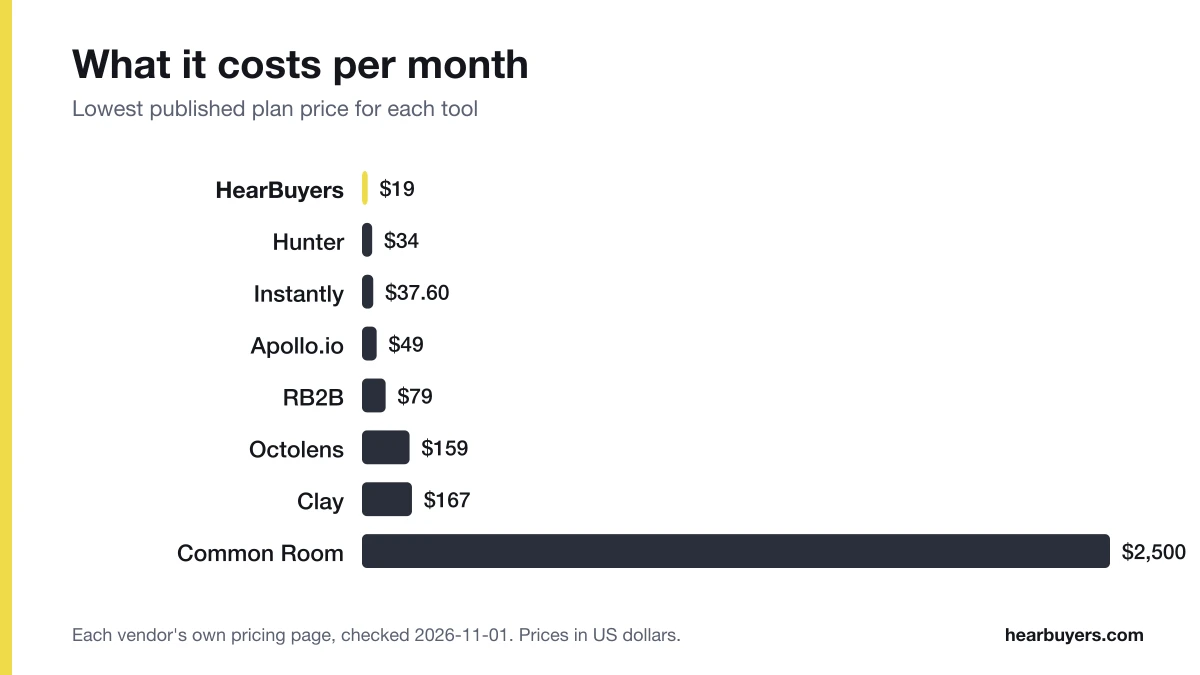
At a glance
| Tool | Job | Starting price (checked 1 Nov 2026) |
|---|---|---|
| Clay | Enrichment and orchestration | Free; $167 a month (annual) |
| Apollo.io | Contact data plus outreach | Free; $49 a seat a month (annual) |
| ZoomInfo | Contact and intent data for large teams | Quote only |
| Hunter | Finding and verifying work emails | Free; $34 a month (yearly) |
| RB2B | Naming website visitors | Free; $79 a month |
| Warmly | Visitor identification with AI chat | From $10,000 a year |
| Common Room | Combined buyer signals | $2,500 a month (annual) |
| Octolens | Mention monitoring across platforms | $159 a month (annual) |
| HearBuyers (ours) | People asking for what you sell on Reddit and X | Free for 14 days, then from $19 a month |
| Instantly | Cold email at volume | $37.60 a month (yearly) |
| HubSpot Sales Hub | CRM and sales software | Free for up to 2 users |
Plans change, so check each vendor's page before you buy.
1. Clay
Clay builds tables that enrich, research and score lists. It pulls from more than 150 data providers in a waterfall and has an AI research agent called Claygent. It also tracks signals such as job changes and web intent, and syncs to your CRM. Actions and data credits are metered separately.
It suits teams with someone who can build and maintain workflows. Prices: Free (500 actions and 100 data credits a month), Launch at $185 a month or $167 billed annually, Growth at $495 or $446 billed annually, and custom Enterprise. If the cost is the issue, see Clay alternatives.
2. Apollo.io
Apollo.io pairs a contact and company database with sequences, a dialer, enrichment, intent topics and website visitor identification, all metered in credits.
It fits small outbound teams that want their data and their sending in one tool. Prices are per seat per month, billed annually: Free, Basic $49, Professional $79 and Organization $119 (minimum three seats). See Apollo.io alternatives.
3. ZoomInfo
ZoomInfo sells contact and company profiles, mobile numbers and business emails. Its Copilot packages add intent signals, website visitors and buying groups.
It suits larger teams that want one data source across regions. Prices aren't listed: cost depends on licenses, features and credit use, and you have to request a quote. See ZoomInfo alternatives.
4. Hunter
Hunter finds and verifies work emails. It has domain search, an email finder and verifier, and cold email sequences, and every plan includes unlimited users.
It suits teams that already know which companies they want and need the right address. Prices: Free (50 credits a month), Starter $34 a month billed yearly ($49 monthly), Growth $104 yearly ($149 monthly), Scale $209 yearly ($299 monthly).
5. RB2B
RB2B names the people and companies visiting your website and sends them to Slack. Person-level identification only works for US visitors.
It fits inbound-heavy teams with US traffic. Prices: Free for company-level identification, Starter $79 a month, Pro from $149 a month, Pro+ from $199 a month.
6. Warmly
Warmly identifies website visitors at the person level, and adds AI chat, inbound agents and signals such as job changes, funding and hiring. Every plan is sold through sales.
It suits teams whose website traffic is high enough to justify the price. The web deanonymization plan starts at $10,000 a year, or $4,875 a quarter.
7. Common Room
Common Room pulls signals from your CRM, product, marketing and community into buyer intelligence at the person level. It adds enrichment, scoring, website deanonymization and alerts.
It fits teams that have several signal sources and want them in one place. Essential costs $2,500 a month billed annually for five seats. Higher tiers are custom, and you have to book a demo.
8. Octolens
Octolens watches Reddit, X and other platforms for mentions of your brand and your competitors. It scores and tags each mention for relevance with AI, then sends alerts to Slack, email or webhooks.
It's built for teams that want wide mention coverage. Pro costs $199 a month, or $159 a month billed annually. Scale costs $599, or $499 billed annually. Both come with a 7-day free trial.
9. HearBuyers (ours)
HearBuyers is ours. It reads public X posts and replies and Reddit posts and comments, looking for people who say they need what you sell. You paste your company website and it fills in your buyers, their problems, search phrases, competitors and subreddits, all of which you can edit. Each post gets a buying-intent score from 0 to 100, and the sentence that shows the need is highlighted. Matches at or above your threshold (70 by default) get a drafted public reply, plus a DM draft on X. A person approves and posts each one. Nothing posts on its own.
It suits teams that want warm conversations rather than a contact database. It covers only X and Reddit, and you won't get emails or phone numbers unless one appears in the post. It's free for 14 days with no card, then from $19 a month.
10. Instantly
Instantly runs cold email at volume, with unlimited sending accounts and warmup, a lead database, enrichment and AI reply tools.
It fits outbound teams sending to large lists. Outreach-only plans start at $47 a month, or $37.60 billed yearly. Bundles that include credits start at $94 a month.
Also in most stacks: a CRM
Every stack needs a place to track deals. HubSpot Sales Hub is free for up to two users, and its pricing page lists the paid tiers per seat. Pipedrive is another common pick, with a 14-day free trial.
How to choose
- Write down the four questions above and mark the ones your team can't answer today.
- Pick one tool for each gap, not one for each vendor demo you sat through.
- Run each new tool on one segment for two weeks before you add the next.
- Check for overlap. Apollo.io, Clay and Instantly all include some enrichment, so you may not need all three.
For a list focused on finding leads, see best lead generation tools. For what to do with a signal once you have it, see buying signals examples.
Frequently asked questions
What is a GTM tool?
Any software a revenue team uses to find, reach or win customers: data providers, enrichment, signal tools, sending tools and the CRM.
What should a small team start with?
One data source, one sending tool and a CRM. Add signals once you know which accounts or conversations convert.
Do GTM tools post or send for you?
Sending tools such as Instantly do, once you approve a campaign. HearBuyers posts nothing itself. You approve each reply and post it yourself.
Sources, checked 1 November 2026: Clay, Apollo.io, ZoomInfo, Hunter, RB2B, Warmly, Common Room, Octolens, Instantly, HubSpot Sales Hub. Product names are trademarks of their owners. HearBuyers is not affiliated with them. Spot something out of date? Write to us and we will fix it.
See who is asking for what you sell
Paste your website. Your first scored matches from X and Reddit arrive within minutes, each with a drafted reply. Free for 14 days, no card.