Best lead generation tools for B2B in 2026, by how they find leads
updated 18 October 2026 · facts about other products checked 18 October 2026 from their own pages
Lead generation tools find people who might buy and give you a way to reach them. Where those leads come from is what separates them: a contact database you search, an enrichment workflow you build, visitors to your own website, or people who say in public that they need something. That source decides what kind of lead you get and how warm it is, so this guide sorts eleven tools by it.
For each tool you get what it does, who it suits, where its leads come from, one standout feature, and the price on the vendor's own page as of 17 or 18 October 2026.

How we ordered this list
The list opens with contact databases, moves through enrichment, LinkedIn, website visitor tools and outreach, and ends with tools that read public posts for stated intent. HearBuyers sits in that last group, labelled as ours. A database tells you who exists and a visitor tool tells you who found you, while a public post tells you who said they have the problem. Because these answer different questions, many teams use two. See also lead source.
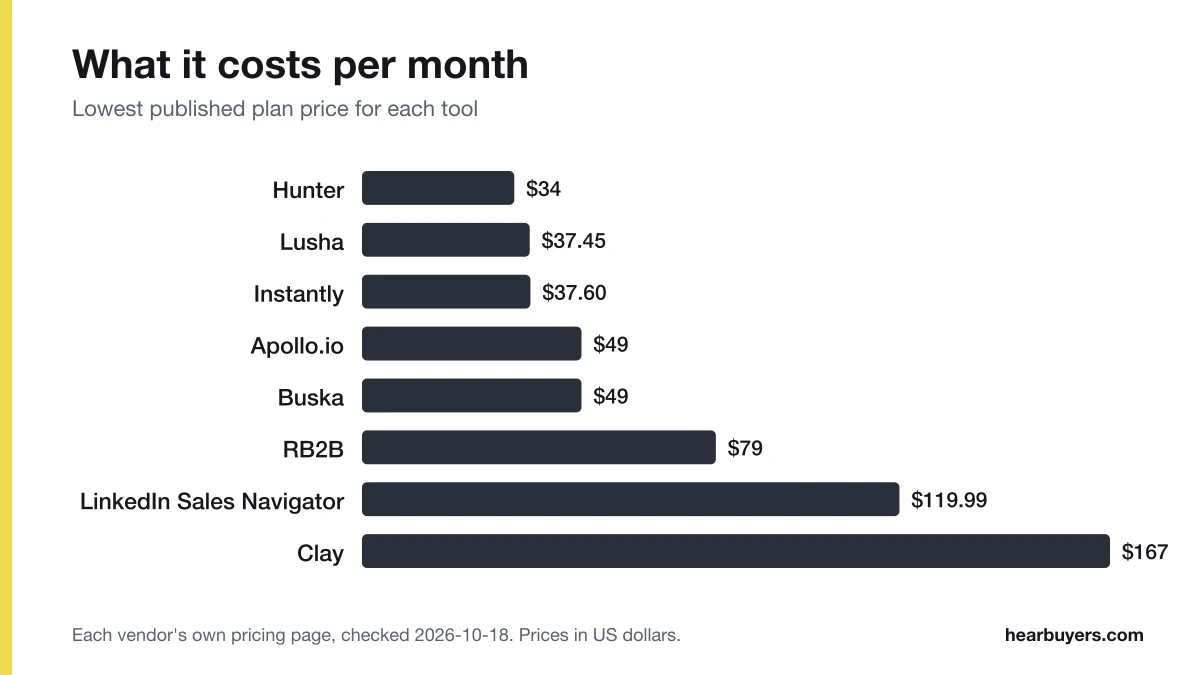
Comparison at a glance
| Tool | Best for | Starting price |
|---|---|---|
| Apollo.io | A searchable database with built-in outreach | Free; paid from $49 a seat a month |
| ZoomInfo | Large teams that want broad data | Not listed (quote) |
| Lusha | Verified emails and phone numbers | Free; paid from $37.45 a month (yearly) |
| Hunter | Finding and verifying work emails | Free; paid from $34 a month (yearly) |
| Clay | Custom enrichment workflows | Free; paid from $167 a month (annual) |
| LinkedIn Sales Navigator | Prospecting inside LinkedIn | From $119.99 a month |
| Leadfeeder (Dealfront) | Identifying companies on your website | Free; paid from €79 a month (annual) |
| RB2B | Naming individual website visitors | Free; paid from $79 a month |
| Instantly | Sending cold email at volume | From $37.60 a month (yearly) |
| Buska | Founders without a sales team | From $49 a month |
| HearBuyers (ours) | People asking for what you sell on X and Reddit | From $19 a month, free for 14 days |
Prices use the plan names and figures each vendor lists on its own pricing page, checked on 17 and 18 October 2026. Plans change, so check the vendor's page before you buy.
1. Apollo.io
Apollo.io pairs a contact and account database with sequences, a dialer, meetings, enrichment, intent topics and website visitor identification. The free plan gives 75 credits per seat per month. An email costs one credit and a phone number eight. Credits don't roll over.
It suits small outbound teams that want to build a list and contact it from the same tool. LinkedIn is one of its integrations.
Its data comes from its own contact and company database.
The free plan stands out, and so does AI lead scoring on the Professional plan.
Prices were checked 17 October 2026. They're per seat per month, billed annually: Free $0, Basic $49 ($65 billed monthly), Professional $79 ($99 monthly) and Organization $119 (minimum 3 seats, $149 monthly). Everything is metered in credits, unused credits don't roll over, and there's a 14-day trial.
2. ZoomInfo
ZoomInfo has contact and company profiles, search and export, mobile numbers and business emails, lists and alerts, CRM integrations and a Chrome extension. The Copilot packages add account prioritisation, buyer intent signals and website visitors.
It suits larger sales teams that want one data source across regions and roles. Pricing depends on licenses, features and credits, and you request it through a form.
Sources: its own contact, company and intent database.
Standout: buyer intent signals and buying groups on the Copilot packages.
Price (checked 17 October 2026): not listed. The pricing page offers Professional, Copilot Advanced and Copilot Enterprise packages through a "Get Pricing" form and says cost depends on licenses, features and credit use.
3. Lusha
Lusha sells B2B contact data: verified emails and phone numbers, company and contact lookalikes, bulk enrichment, and buying-intent topics and signals. It syncs with CRMs and has a Chrome extension.
It suits reps who already know who they want to reach and need a direct dial or a confirmed email. Lusha supplies data and does no social listening.
The data comes from its own contact and company database, plus the Chrome extension.
The free plan stands out: 40 credits a month, and you don't need a card to sign up.
Prices as checked on 18 October 2026: Free is $0 (40 credits a month), Starter is $37.45 a month billed yearly ($49.90 monthly), Pro is $52.45 yearly ($69.90 monthly), Premium is $299.95 yearly ($399.90 monthly), and Scale is on request. A verified email costs 1 credit and a phone number 5.
4. Hunter
Hunter finds and verifies professional email addresses. It offers Domain Search, Email Finder, Email Verifier, bulk jobs and a Discover database with an AI assistant, and it also runs cold email campaigns and sequences. Finding an email costs one credit; verifying one costs half a credit.
It suits founders and small teams who already know whom they want to reach and only need the address. Its pages don't describe monitoring social platforms.
Its coverage is the work email addresses it finds and verifies.
Two things set it apart: a free plan with 50 credits a month, and unlimited users on every plan.
Prices, checked 18 October 2026: Free $0 (50 credits a month), Starter $49 a month ($34 billed yearly; 2,000 credits), Growth $149 ($104 yearly; 10,000 credits), Scale $299 ($209 yearly; 25,000 credits), and Enterprise on request.
5. Clay
Clay pulls lead data from 150+ providers in sequence and has an AI research agent called Claygent. Work can be triggered by signals such as job changes, company news, social listening and web intent, and it includes a sequencer and CRM sync.
It suits revenue operations people and technical founders who want to build their own lead workflow. Usage is metered in actions and data credits.
Sources: 150+ data providers through waterfall enrichment.
Standout: waterfall enrichment across multiple providers.
Price (checked 17 October 2026): Free is $0 (500 actions and 100 data credits a month), Launch is $185 a month billed monthly or $167 a month annually, and Growth is $495 a month monthly or $446 annually. Actions and data credits are separate meters that scale in tiers. Enterprise is custom. Launch and Growth have a 14-day trial.
6. LinkedIn sales Navigator
Sales Navigator is LinkedIn's sales product. It adds 50+ search filters, AI insights on accounts and leads, buyer intent, job-change alerts, relationship maps and AI-assisted messaging, and it integrates with CRMs.
It suits sellers whose buyers are active on LinkedIn. It only works with LinkedIn data, so it won't monitor Reddit or X.
It draws on LinkedIn profiles, accounts and activity.
The standout feature is the alert when a saved lead changes jobs or posts.
Price (checked 18 October 2026): Core starts at US$119.99 a month ($1,079.88 a year) and Advanced at US$159.99 a month ($1,799.88 a year). Advanced Plus is priced by demo. Eligible members can start a free trial, but it needs payment details.
7. Leadfeeder (Dealfront)
Leadfeeder, from Dealfront, shows you which companies visit your website. Higher plans add verified emails and phone numbers, intent filters, B2B display campaigns and CRM automation. The Lite plan is free forever and covers the last 100 companies a month.
It suits teams with steady traffic who want to know which accounts to chase. Identification stops at the company: you learn which company visited, not which person.
Sources: visits to your own website, identified at company level.
Standout: a free forever plan with unlimited users.
Price (checked 17 October 2026): Lite is free forever (last 100 companies a month), Discover starts at €79 a month billed annually (€113 monthly), Activate starts at €369 a month annually, and Scale starts at €599 a month annually. The page showed euros for our location.
8. RB2B
RB2B identifies the people visiting your site as well as their companies, and sends their LinkedIn profile URLs to Slack. Its own coverage table says person-level identification works only in the US and reaches 15 to 20 percent of visitors on Starter and Pro, rising to 35 to 45 percent on Pro+. Business email addresses start on the Pro plan.
It suits US-focused sellers who already get web traffic. Check your market's privacy rules before turning on person-level identification.
Its only source is visits to your own website. The standout is free company-level identification with Slack alerts.
As of 17 October 2026, Free costs $0 (150 monthly resolutions, company level), Starter is $79 a month, Pro starts at $149 a month and Pro+ at $199 a month. Its own table puts person-level identification at US only, covering 15-20% of visitors on Starter and Pro.
9. Instantly
Instantly is an outreach platform that bundles unlimited email accounts and warmup, a lead database, an AI reply agent, a unified inbox and a CRM. It sends cold email at volume and includes deliverability tools.
It suits teams that already know their audience and need a sender, or that want leads and sending in one place.
Sources. Its B2B lead database of 450M+ leads (its figure).
Standout. Unlimited email accounts and warmup on the outreach plans.
Price (checked 18 October 2026). Outreach-only plans start with Growth at $47 a month ($37.60 billed yearly) and Hypergrowth at $97 ($77.60 yearly). Credit plans start at $47. Bundles start with Starter at $94 a month ($85 yearly). VIP is custom.
10. Buska
Buska finds buyers through social listening. You enter your website and it listens across its sources, scores each lead as hot or warm, and drafts a reply. Leads move across a kanban dashboard from "to qualify" to "won".
It suits founders who want a short daily list of people who've said they need something. The Scale plan adds an AI SDR agent, which its table describes as outreach you approve.
Sources: 16+ on Starter and up to 33+ on Scale, including X, Reddit, YouTube, Hacker News, Bluesky, LinkedIn and Indie Hackers.
Standout: a daily digest of scored leads, with alerts by Slack, Discord, email or webhook.
Price (checked 17 October 2026): Starter is $49 a month (5 signals), Growth is $99 a month (15 signals, reply studio) and Scale is $249 a month (30 signals, AI SDR agent). Paying annually saves about two months. The free trial runs 7 days and needs no card.
11. HearBuyers (ours)
HearBuyers is ours. It finds leads in public posts: people on X and Reddit who say they need what you sell. Each post gets a buying-intent score from 0 to 100, with the sentence behind the score highlighted. When a match reaches your threshold (70 by default), HearBuyers drafts a public reply, plus a DM on X. A person approves and posts each one.
It suits teams that want warm leads and don't need a contact database. You get no phone numbers, and no emails unless one appears publicly in the post. It covers only X and Reddit.
It reads X posts and replies, Reddit posts and comments in the subreddits you choose, and Reddit search. Hacker News is next.
The difference is that every lead arrives as a post with a visible sentence of need, so you start with context.
It's free for 14 days with no card, then from $19 a month.
What r/LeadGeneration and r/sales use
Threads on r/LeadGeneration, r/sales and r/b2bmarketing in 2026 keep returning to two problems: data goes stale, and timing is hard. People say lists age fast, so they check contact data before sending to it. Many say reaching people at the right moment did more for them than a bigger database. "Fresh data beats big databases every time," as u/kellyjames436 put it in r/Entrepreneur (comment).
Public posts help with timing. In our scans of 19 service niches between 16 and 18 October 2026, we found 568 people asking in public to hire or buy, and 544 of them were on Reddit (research). Buying signals examples covers the signals that predict a purchase, and how we research Reddit explains how we read these threads.
How to choose
- Decide which job the tool has to do in your stack; best GTM tools groups the options by job. Then decide how warm the lead needs to be. A database gives you cold names. A site visit gives you someone who has seen you. A public post gives you someone who has said they need something.
- Check coverage for your market by testing a sample of roles and regions before you pay.
- Count credits, not features. Most database tools meter by credit, so estimate your monthly use.
- Don't buy everything at once. One data source and one outreach method are enough to learn what works.
- Mind consent and privacy. Identification tools and cold outreach both come with legal rules, and those rules vary by region.
- Keep a person on the reply. Automated messages teach recipients to ignore you.
A note on Reddit's data access
Reddit is changing who can access its public data between 31 October 2026 and March 2027, so a tool that reads Reddit from outside may cover less in that window. Later for Reddit, for example, announced on 3 October 2026 that its posting will stop on 1 January 2027. Ask each vendor what it will still be able to read on Reddit after the change.
Frequently asked questions
What are the best lead generation tools?
It depends on how you want to find leads. Databases like Apollo and ZoomInfo find names. Website tools like Leadfeeder find visitors. Tools like Buska and HearBuyers find people who stated a need in public.
What is the difference between lead generation and prospecting?
Lead generation brings potential buyers into view. Prospecting is choosing which of them to contact. See prospecting.
Are there free lead generation tools?
Yes. Apollo, Lusha, Hunter, Leadfeeder and RB2B all list free plans, with limits.
Can AI do lead generation?
It can find, enrich, score and draft, but a person still has to handle the final step. See our guide to AI lead generation.
Next step
Pick the one lead source that fits your buyer, run it for two weeks, and count conversations, not leads. If you're going the public-post route, start with Reddit lead generation.
*Product names belong to their owners, and HearBuyers isn't affiliated with any of them. Facts about other products come from their own pages on the dates shown.*
Sources, checked 18 October 2026: Apollo.io, ZoomInfo, Lusha, Hunter, Clay, LinkedIn Sales Navigator, Leadfeeder (Dealfront), RB2B, Instantly, Buska. Product names are trademarks of their owners. HearBuyers is not affiliated with them. Spot something out of date? Write to us and we will fix it.
See who is asking for what you sell
Paste your website. Your first scored matches from X and Reddit arrive within minutes, each with a drafted reply. Free for 14 days, no card.