Best sales intelligence tools, compared by data and price
updated 18 October 2026 · facts about other products checked 18 October 2026 from their own pages
The best sales intelligence tool is the one that matches how your team prospects. If you need contact details for a defined list of companies, start with a contact database such as Apollo or Lusha. If you build lists from many data sources, look at Clay. If you sell into named accounts and want buying signals across the whole funnel, look at ZoomInfo, 6sense or Common Room, and expect a sales call before you see a price. Sales intelligence tools tell you who to contact and why now. Most of them work from databases and your own site traffic, not from what strangers say in public posts.
The list is ordered by fit for a small team that needs to start this month. Tools with published prices and a free or low-cost entry come first, and demo-only platforms come last. Every fact comes from the vendor's own pages, read on 17 or 18 October 2026. Prices change, so confirm on the vendor's page before you buy.

The tools side by side
| Tool | Best for | Data sources | Price as listed | Checked |
|---|---|---|---|---|
| Apollo | Small teams that want data and outreach in one place | Contact and account database, intent topics, website visitors | Free; paid from $49 per seat a month billed annually | 17 Oct 2026 |
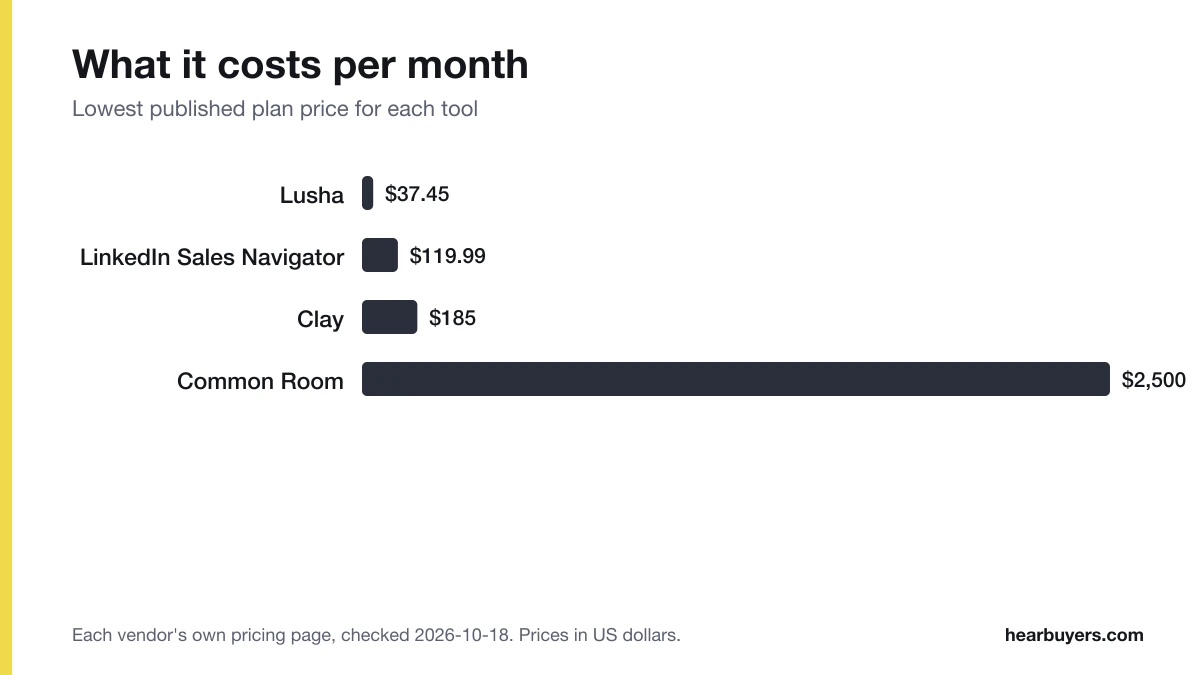
| Lusha | Reps who need verified emails and phone numbers | B2B contact and company data, buying-intent topics | Free; paid from $37.45 a month billed yearly | 18 Oct 2026 |
| Clay | Teams that build custom lists from many providers | 150+ data providers plus signals | Free; Launch $185 a month billed monthly | 17 Oct 2026 |
| LinkedIn Sales Navigator | Reps whose buyers live on LinkedIn | LinkedIn profiles, accounts and activity | Core from US$119.99 a month | 18 Oct 2026 |
| ZoomInfo | Larger sales teams with a data budget | Contact and company profiles, buyer intent signals | Not listed, form required | 17 Oct 2026 |
| Leadfeeder | Spotting which companies visit your site | Website visits, company data | Free Lite; Discover from €79 a month billed annually | 17 Oct 2026 |
| Common Room | Teams combining CRM, product and community signals | CRM, product, marketing and engagement signals | Essential $2,500 a month billed annually | 17 Oct 2026 |
| 6sense | Account-based teams with predictive models | Intent, verified B2B data, website visitor identification | Not listed, demo required | 17 Oct 2026 |
Apollo
Apollo describes itself as an all-in-one platform covering contact and account data, sequences, a dialer, meetings and deal management. It also lists enrichment, intent topics and website visitor identification. It suits a founder or a two-person sales team that wants a database and outreach under one login.
The free plan is the main draw: 900 credits per seat per year, two sequences and one intent topic. Basic is $49 per seat a month billed annually ($65 billed monthly), Professional is $79 ($99 monthly), and Organization is $119 billed annually with a three-seat minimum. A 14-day trial is offered.
Its pricing page notes that credits are pooled across the team, granted each cycle and do not roll over, and all seats on an account must be on the same plan. Prices were checked on 17 October 2026. For a closer look, see Apollo vs ZoomInfo and the Apollo pricing guide.
Lusha
Lusha calls itself the B2B data and intelligence layer for go-to-market teams. It sells verified emails and phone numbers, company and contact lookalikes, buying-intent topics and signals, and a Chrome extension. It suits individual reps who mostly need to reach a person they have already identified.
The credit rule is easy to follow: a verified email costs 1 credit and a phone number costs 5. Free is $0 for 40 credits a month. Starter is $37.45 a month billed yearly ($49.90 billed monthly), Pro is $52.45 yearly ($69.90 monthly) and Premium is $299.95 yearly ($399.90 monthly). Scale is custom.
Its pages describe contact data, not conversation monitoring, so it will not tell you who is asking for a tool today. Annual plans grant all credits up front, and unused credits reset at the end of the cycle. Checked 18 October 2026.
Clay
Clay builds lists by pulling data from 150+ providers in sequence, a method it calls waterfall enrichment. It also has an AI research agent called Claygent, a sequencer, CRM sync and signals such as job changes and company news. It suits a growth or RevOps person who is comfortable building a workflow.
Clay is the most flexible tool here. Free is $0 with 500 actions and 100 data credits a month. Launch is $185 a month billed monthly or $167 billed annually. Growth is $495 monthly or $446 annually. Enterprise is custom, and a 14-day trial covers Launch and Growth.
Clay meters two things, actions and data credits, so your monthly cost depends on the tiers you pick. The Free plan caps tables at 200 rows. Checked 17 October 2026.
LinkedIn sales Navigator
Sales Navigator is LinkedIn's own sales product. LinkedIn lists 50+ search filters, AI insights on accounts and leads, buyer intent, alerts on job changes and new content, relationship mapping and CRM integrations. It suits reps whose buyers keep an active LinkedIn profile.
It runs on LinkedIn's own profiles, accounts and activity, which no outside tool can fully mirror. Core starts at US$119.99 a month or US$1,079.88 a year, Advanced at US$159.99 a month or US$1,799.88 a year, and Advanced Plus is quoted by demo.
The free trial needs payment details up front, and you must cancel before it ends to avoid a charge. The pages we read describe LinkedIn data, not Reddit or X conversations. Checked 18 October 2026.
ZoomInfo
ZoomInfo sells Sales, Marketing and Talent packages. In Sales, it lists ZoomInfo Professional for contact and company profiles, lists and a Chrome extension. Copilot Advanced adds buyer intent signals, website visitors and buying groups, and Copilot Enterprise adds custom intent signals and competitor alerts. It suits larger teams that want one broad data source.
The upper tiers go deepest on intent and signals. No price is listed. The pricing page offers a "Get Pricing" form and a free trial button, and the FAQ says cost depends on features, the number of licenses and credit use.
That means you cannot compare a price before talking to the vendor. Checked 17 October 2026. See Apollo vs ZoomInfo for a side-by-side view.
Leadfeeder
Leadfeeder, from Dealfront, identifies which companies visit your website. It suits a team with steady site traffic that wants to know who is already looking.
It has a free forever tier. Lite is €0 with unlimited users, 7-day visitor history and the last 100 companies a month. Discover starts at €79 a month billed annually (€113 billed monthly). Activate starts at €369 billed annually and adds verified emails and phones. Scale starts at €599, billed annually only. The page showed euros for our location.
It counts one identified company per month however often that company returns, and plans are tiered by companies identified. Checked 17 October 2026.
Common Room
Common Room positions itself as buyer intelligence that unifies signals from your CRM, product, marketing and engagement. It lists person-level enrichment, AI scoring, buying committee mapping, website deanonymization, job change tracking and "Social & Community Engagement" signals. It suits mid-market and enterprise teams that have product or community activity to read.
It puts first-party signals and Bombora topics in one place.
Essential is $2,500 a month billed annually, with 5 seats and up to 100k contacts. Advanced and Enterprise are custom, and a demo is required. The entry price is a team budget, not a solo one. Checked 17 October 2026. See Common Room vs Trigify.
6sense
6sense calls its product "Intelligence for Agentic GTM". It covers intent, verified B2B data and technographics, website visitor identification and predictive models. Its sales intelligence page shows three packages built from Sales Intelligence, Data Credits and Predictive AI. It suits account-based teams that already have a data operation behind them.
What sets it apart is predictive models alongside third-party intent. No price is listed, only a "Book Your Demo" button. Data credits are spent to reveal and export emails, phone numbers and enriched records, so contact data is metered. Checked 17 October 2026.
Where HearBuyers (ours) fits
HearBuyers does a different job. It reads public posts on X and Reddit and scores each one for buying intent from 0 to 100. It highlights the sentence that shows the need and drafts a reply for a person to approve and post. It holds no contact database. Use it alongside the tools above when you want people who just asked for what you sell, not a list of companies that fit your profile. HearBuyers is free for 14 days with no card, then from $19 a month. See how it works and sales signals.
How to choose
- Start with the question. "Who should I contact?" needs a database: Apollo, Lusha, ZoomInfo or Sales Navigator. "Who is ready now?" needs signals: Common Room, 6sense, Leadfeeder or a conversation tool.
- Check the meter. Credits, actions, seats and identified companies are different units, so estimate your monthly volume before you compare prices.
- Prefer a price you can read. If a vendor lists none, ask for a written quote and a contract length.
- Test on your own list. Run 50 accounts you already know through two tools and count how many contacts are correct.
Frequently asked questions
What is a sales intelligence tool?
Sales intelligence software gives sellers data about prospects: contact details, company facts and signals that suggest a good time to reach out. Many tools also handle outreach and CRM sync.
Which sales intelligence tool has a free plan?
Apollo, Lusha, Clay and Leadfeeder each list a free plan, with limits, on their own pages. Apollo gives 900 credits per seat per year, Lusha 40 credits a month, Clay 500 actions and 100 data credits a month, and Leadfeeder a free Lite tier.
Is sales intelligence the same as intent data?
No. Sales intelligence is the wider category of prospect data, and intent data is one kind of signal inside it. Our intent data providers list covers that part.
Do these tools find people asking for recommendations on Reddit or X?
The pages we read for these eight vendors do not describe that. Conversation tools do, and our social listening list covers them.
Next step: pick two tools from this list, run the same 50 accounts through both, and keep the one whose contacts you would actually email.
Sources, checked 18 October 2026: Apollo pricing, Lusha pricing, Clay pricing, LinkedIn Sales Navigator plans, ZoomInfo pricing, Leadfeeder pricing, Common Room pricing, 6sense pricing. Product names are trademarks of their owners. HearBuyers is not affiliated with them. Spot something out of date? Write to us and we will fix it.
See who is asking for what you sell
Paste your website. Your first scored matches from X and Reddit arrive within minutes, each with a drafted reply. Free for 14 days, no card.