Apollo pricing: what each plan costs per seat
updated 18 October 2026 · facts about other products checked 17 October 2026 from their own pages
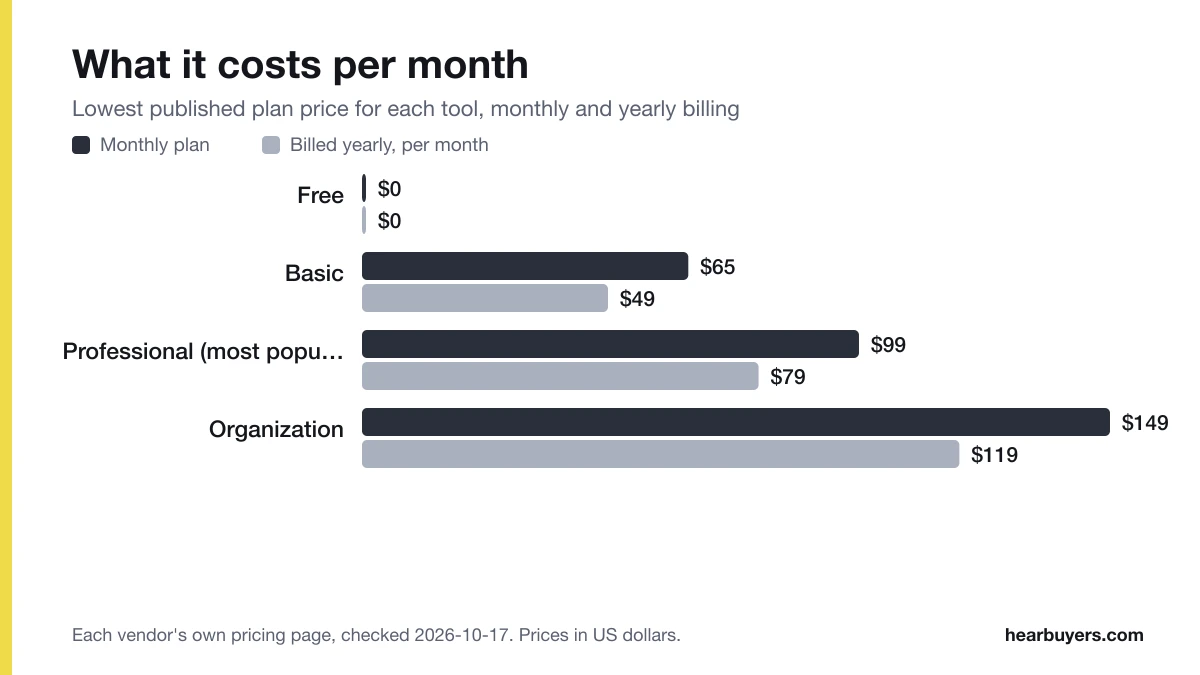
Apollo's Free plan costs $0. Basic, Professional and Organization cost $49, $79 and $119 per seat a month billed annually, or $65, $99 and $149 billed monthly. Every paid plan comes with a credit allowance per seat, and revealing emails, phone numbers and enriched data spends those credits.
These prices come from Apollo's own pricing page, checked on 17 October 2026. The page says prices exclude taxes and describes its pricing as introductory.

Apollo plans and prices
| Plan | Billed annually (per seat a month) | Billed monthly | Credits per seat |
|---|---|---|---|
| Free | $0 | $0 | 900 a year, granted monthly (75 a month) |
| Basic | $49 | $65 | 30,000 a year (2,500 a month) |
| Professional (most popular) | $79 | $99 | 48,000 a year (4,000 a month) |
| Organization | $119, minimum 3 seats | $149, annual only | 72,000 a year |
Annual billing is marked "Save 24%".
What each plan includes
- Free: 2 sequences, basic filters, 20 website-visitor companies a month, 1 intent topic, and Gmail only for email.
- Basic: unlimited sequences, advanced filters, 6 intent topics, CRM integrations and 5 workflows.
- Professional: adds AI lead scoring, A/Z testing, and call recordings with AI insights (4,000 minutes).
- Organization: 12 intent topics, 8,000 call minutes and unlimited inbound routers.
Add-ons and credit costs
Add-ons are priced per team per month. Inbound Essentials is $119 (or $639 for Max) billed annually, and $149 or $799 billed monthly. Advanced Dialer is $119 billed annually and $149 monthly.
An email costs 1 credit and a phone number 8. Enrichment costs 1 to 8, an AI research run 1, and the US dialer 1 per 30 seconds. Credits are pooled across the team and granted up front each cycle, and they do not roll over. Extra credits are bought with a slider and recur until you remove them.
What drives the bill up
Apollo's page lists what drives the cost. The price multiplies with seats, and every seat on an account has to be on the same plan. A phone number costs 8 times what an email does, so a workflow that reveals a lot of phone numbers burns through credits quickly. Extra credits keep recurring until you remove them.
How to estimate your cost
- Count the seats that will use Apollo.
- Estimate how many contacts you will reveal each month, and how many of those need phone numbers.
- Convert that to credits: 1 per email, 8 per phone number.
- Compare the total with each plan's per-seat allowance. Because credits are pooled, a team of three on Basic holds 7,500 a month.
- Add the plan price per seat, then any add-ons.
The 14-day trial gives you 75 credits and most features. When it ends you can upgrade or drop to the free plan.
Alternatives and other categories
For a quote-based platform, see ZoomInfo pricing, or read the direct Apollo vs ZoomInfo comparison. For workflow-first enrichment with usage meters, see Clay pricing.
HearBuyers is not a contact database. It finds public posts on X and Reddit where someone is asking for what you sell, then drafts a reply for a person to approve. You can run it alongside Apollo. For other tools that cover parts of what Apollo does, see Apollo.io alternatives.
Next step: before you pick a plan, add up your seats and the contacts you reveal in a month, and test your filters on the free plan.
Sources, checked 17 October 2026: Apollo pricing, Apollo home. Product names are trademarks of their owners. HearBuyers is not affiliated with them. Spot something out of date? Write to us and we will fix it.
See who is asking for what you sell
Paste your website. Your first scored matches from X and Reddit arrive within minutes, each with a drafted reply. Free for 14 days, no card.